

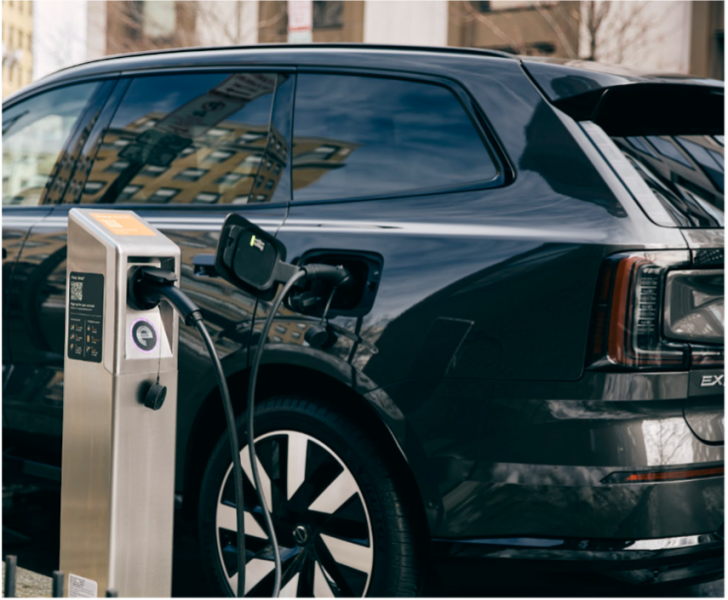
 Electric vehicles are a cleaner, more sustainable alternative to traditional fossil fuel-powered vehicles. With new charging stations being installed, available financial incentives and lower-cost previously-owned vehicles entering the market, owning or leasing an EV is becoming an increasingly accessible and cost-effective option for District residents.
This page provides information on available resources, incentives, and programs for electric vehicles and EV charging in the District of Columbia.
Contact DOEE staff for more information: [email protected]
District Transportation Electrification Policies and Legislation
The Clean Energy DC Omnibus Act of 2018
The Clean Energy DC Omnibus Act of 2018 is a foundational piece of legislation that mandates a transition to 100% renewable electricity by 2032 and a zero-emission transportation sector by 2045. The Clean Energy DC Act establishes three main transportation goals:
- 25% or more of all vehicles registered in DC be zero-emission by 2030.
- 100% of all public and school buses are replaced with electric models as they reach the end of their useful life.
- 100% of public buses, public fleets, privately-owned fleets with a capacity of 50 or more passengers, and taxis and limousines are to be zero-emission by 2045 (and 50% zero-emissions by 2030).
Transportation Electrification Roadmap
The District adopted the Transportation Electrification Roadmap (TER), to provide guidance for meeting the three overarching transportation electrification goals in the Clean Energy DC Omnibus Act of 2018. The Roadmap is one part of the District’s larger effort to meet climate goals and energy targets, building towards the goal of becoming carbon neutral by 2045.
Comprehensive Electric Vehicle Infrastructure Access, Readiness, and Sustainability Amendment Act of 2024.
Since 2018, DC has expanded the zero-emission transportation framework with the Comprehensive Electric Vehicle Infrastructure Access, Readiness, and Sustainability Amendment Act of 2024. The Comprehensive EV Infrastructure Act includes key provisions to expand EV charging in DC, including:
- Right to Charge - grants all multifamily home residents the legal right to install EV charging, provided they follow certain safety, installation, building owner approval procedures.
- EV-Ready and EV-Installed Building Mandates - requirements to include infrastructure to accommodate onsite EV charging in new or substantially improved commercial, multi-unit, and single-family home buildings.
- Gas Station Fast Charging - Requires high-volume retail gas stations (selling more than one million gallons per year) to install at least one DC fast-charging port during major renovations.
- Neighborhood EV Charging Infrastructure Pilot Program - established to increase publicly accessible EV charging in priority areas across the District.
Full enforcement of the Comprehensive EV Infrastructure Act remains subject to the remaining funding’s inclusion in an approved budget and financial plan.
District EV Dashboard
The District EV Dashboard is an interactive tool designed to track the District’s progress toward transportation electrification goals by providing data on EV registrations and public charging infrastructure. The dashboard allows users to locate public EV chargers, filter data by charger type, and view EV registrations by ward.

Click the above image above to access the District EV Dashboard.
This dashboard is updated quarterly to reflect the most up to date information about EV registrations in the District.
Financial Incentives and Local Resources for EVs and EV Charging
Governments and utility companies offer financial incentives designed to lower the cost of electric vehicles and EV charging.
Listed below are federal, District, and utility company financial incentives available to District residents and businesses.
Electric Vehicle Incentives
District Incentives
Alternative Fuel Conversion Credit
The District offers an income tax credit, known as the Alternative Fuel Conversion Tax Credit, to individuals and businesses that convert vehicles to operate on qualified alternative fuels. Eligible taxpayers may claim an income tax credit of 50% of the equipment and labor costs for a conversion, up to $19,000 per vehicle (uncapped for certain businesses). This tax credit is non-refundable and leftover amounts cannot be carried forward to future tax years.
Qualified alternative fuels include ethanol blends of at least 85%, natural gas, compressed natural gas, liquefied natural gas, liquefied petroleum gas, biodiesel (excluding kerosene), electricity, or hydrogen.
The District’s Alternative Fuel Conversion Credit expires on December 31, 2026. More information is available on the DC Office of Tax and Revenue website.
Reduced Vehicle Registration Fees
Battery electric vehicles are eligible for reduced vehicle registration fees in the District.
For the initial two-year registration period with the District Department of Motor Vehicles (DMV) new battery electric vehicles less than 5,000 lbs. qualify for a reduced registration fee of $40.
After two years, battery electric passenger vehicles are treated according to their vehicle weight class, but may subtract 1000 lbs. from their manufacture’s weight and pay the applicable annual fee.
Plug-in hybrid electric vehicles and hybrid vehicles do not qualify for reduced vehicle registration fees.
More information on vehicle registration fees is available on the DMV website.
Reduced Excise Tax
An excise tax is a one-time fee paid when a vehicle is first titled in the District. Instead of using a flat rate, the District uses a sliding scale to tax vehicles based on vehicle weight and fuel efficiency, with more fuel-efficient and lightweight vehicles paying less in excise taxes.
Electric vehicles pay reduced excise taxes, ranging from 1% - 3% of the vehicle’s fair market value, depending on vehicle weight. Prior to February 2025, fully electric vehicles were exempt from the excise tax.
High-efficiency vehicles, such as plug-in hybrid and hybrid vehicles, or gas-powered vehicles that have a fuel efficiency of at least 40 miles per gallon city driving, also qualify for lower excise tax rates, between 1.5% - 3.5% of the vehicle’s fair market value, depending on vehicle weight.
Heavier and less fuel-efficient vehicles pay an excise tax rate between 5% - 11% of the vehicle’s fair market value, depending on vehicle weight.
The reduced excise tax only applies to newly registered vehicles and does not apply to vehicle leases.
More information about excise tax fees is available on the DMV website.
EV Charging Incentives
Federal Incentives
Alternative Fuel Vehicle Refueling Property Credit
The Federal government offers an income tax credit, known as the Alternative Fuel Vehicle Refueling Property Credit (Section 30C), to individuals, businesses, and tax-exempt entities for the purchase and installation of EV charging stations and other alternative fuel infrastructure in eligible census tracts.
Residential claimants can receive 30% of hardware and installation costs, up to $1,000 per charging port.
Businesses and tax-exempt entities can claim between 6% - 30% of hardware and installation costs, up to $100,000 per port, depending on wage and apprenticeship requirements.
This federal tax credit is scheduled to expire on June 30, 2026. All equipment must be fully installed and placed in service by this date to be eligible. To claim the tax credit, taxpayers must file IRS Form 8911 with their federal income tax return for the year the installation was completed.
More information on the Federal Alternative Fuel Vehicle Refueling Property Credit (Section 30C) can be found on the US Internal Revenue Service website.
Additional federal incentives can be found at the US Department of Energy Alternative Fuels Data Center’s Federal and State Laws and Incentives database.
Local Incentives
Alternative Fuel Infrastructure Credit
The District offers an income tax credit, known as the Alternative Fuel Infrastructure Credit, for residents and businesses that purchase and install alternative fuel storage, dispensing, or charging equipment within the District.
Individual taxpayers who install EV charging equipment on a residential property can claim 50% of allowable equipment and installation costs, up to $1,000 per charging station.
Unincorporated businesses that install EV charging equipment that is available for use by the public on a non-residential property can claim 50% of allowable equipment and installation costs, up to $10,000 per charging station.
Corporations that install EV charging equipment that is available for use by the public on a non-residential property can claim 50% of allowable equipment and installation costs, with no cap on the amount that can be claimed per charging station.
The infrastructure credit cannot exceed the taxpayer’s liability in the year it is claimed, however, any unused portion of the tax credit may be carried forward for up to two years.
DC’s Alternative Fuel Infrastructure Credit expires on December 31, 2026. More information on how to claim this credit is available in the Alternative Fuel Vehicle Infrastructure and Conversion Credits FAQ document on the DC Office of Tax and Revenue website.
Utility Incentives
Pepco Residential Whole House Time-of-Use Rate
Pepco, the public electric utility company in DC, offers a Whole House Time-of-Use (TOU) Rate for residential customers with an EV charger.
The TOU Rate is lower than the Standard rate during off-peak hours while slightly higher during peak hours, allowing customers with an EV charger to save money while electricity rates are lower, potentially lowering their monthly electricity bill.
District residents with an EV capable of traveling 30 miles using electricity as fuel, without the use of gas and who register their vehicle in the District can apply for the Whole-Home Time-of-Use Rate through Pepco.
More information on the Residential Whole House Time-of-Use Rate and how to apply is available on the Pepco DC website.
EV Charging Service Providers
Contractors on this list have been verified by the Department of Licensing & Consumer Protection (DLCP) to have, at the time of its creation, active and proper business licensing to perform EV charging equipment installation services in the District. This list was last updated in July 2024. Contact information for the contractors (also listed below) are available. The DC Government does not endorse nor sponsor any of the listed companies. If you would like to be added to the list of contractors, please email: [email protected].
| Company | Residential | Commercial | Multifamily |
|
Blue Whale EV |
X |
X |
|
|
Citizen Energy, LLC |
X |
X |
X |
|
District Fleet e-Mobility |
|
X |
X |
|
ENGIE Service US Inc. |
|
X |
|
|
Green Compass |
|
|
|
|
JLL |
X |
X |
X |
|
Lightility, LLC |
|
X |
X |
|
SKYHOOK Solar Corp |
X |
X |
X |
|
Sunpower by EDGE Energy |
X |
|
X |
EV Workforce Development Programs
The following is a list of local workforce development programs and trainings for those looking to gain certifications and job training in the EV industry.
*The DC Government does not endorse nor sponsor any of the listed programs.
| Program | Description | Duration | Requirements | Estimated Cost |
|
Job training program where students learn how to diagnose and safely repair hybrid and electric vehicles |
2-3 months |
Must be 18+ and have a valid driver’s license |
$779 Cost deductions available for Carroll County and Maryland residents |
|
|
District of Columbia Sustainable Energy Utility (DCSEU): |
Paid externships and trainings with local contractors and organizations |
5 months |
DC resident |
N/A |
|
Training for installing EVSE equipment and an overview of the EV industry |
20 hours course with exam |
Must be a state licensed or certified electrician to participate |
$275 |
|
|
Improve technical knowledge to diagnose, service and repair high voltage EVs |
Online, self-paced, independent study program |
No background in auto mechanics required |
~$1800 plus registration fees |
|
|
Occupational skills and work-based learning to prepare students for employment in renewable energy industry |
Varies |
Prince George’s County resident, possess high school diploma or GED, and have experience in the energy sector |
Courses are tuition free for Prince George’s County residents |
Other Information Resources
Other informational resources on EVs, EV charging infrastructure, and incentives that may be beneficial for District residents are listed below:
- US Department of Energy Vehicle Cost Calculator: The US Department of Energy has a vehicle cost calculator that uses basic information about driving habits to determine the total cost of ownership and emissions for makes and models of most vehicles.
- US Department of Energy EV Charging Station Locator: The US Department of Energy maintains an interactive database of publicly accessible charging stations in the United States and Canada.
- Virginia Department of Energy Transportation Programs: Learn more about electric vehicle and EV charging programs available to Viriginia residents and businesses.
- Maryland Energy Administration Clean Transportation Incentives: Learn more about electric vehicle and EV charging programs available to Maryland residents and businesses.
